Disaster Medicine & Global Health Security for Low- & Middle-Income Countries (LMICs)
Facing the Future: New Challenges from Climate Change, Conflict, and Migration
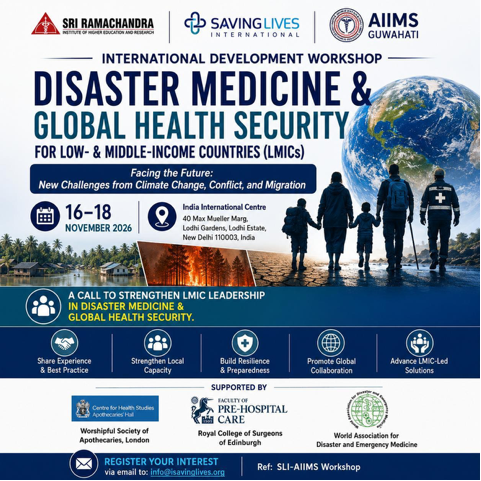
A CALL TO STRENGTHEN LMIC LEADERSHIP IN DISASTER MEDICINE & GLOBAL HEALTH SECURITY.
Low- and Middle-Income Countries (LMICs) are increasingly affected by disasters, humanitarian crises, climate-related emergencies, conflicts, population displacement, and emerging infectious disease threats. At the same time, declining international aid is placing greater responsibility on national and regional systems to strengthen self-reliance in preparedness, response, recovery, and resilience.
The COVID-19 pandemic and recurring Ebola outbreaks have demonstrated that health emergencies do not respect borders, reinforcing the critical importance of Disaster Medicine, Humanitarian Medicine, and Global Health Security. Strengthening preparedness, surveillance, resilient health systems, and international collaboration is essential to protecting populations and reducing the impact of future crises.
This international workshop invites leaders in disaster and humanitarian medicine, public health, academia, government, humanitarian organisations, and policymakers to work together in identifying practical solutions that strengthen Disaster Medicine, advance Global Health Security, and build sustainable, LMIC-led capacity for future emergencies.
Workshop objectives
- ◆Examine emerging disaster and humanitarian challenges affecting LMICs
- ◆Strengthen Disaster Medicine and Humanitarian Medicine capacity
- ◆Advance Global Health Security through collaboration and shared learning
- ◆Identify practical, affordable, and scalable LMIC-led solutions
- ◆Build sustainable partnerships between institutions and countries
- ◆Develop recommendations for future policy, education, and research
Why this workshop matters
Drawing on more than 30 years of international disaster response, recovery, education, and health system development, Saving Lives International has identified Disaster Medicine and Global Health Security as two critical priorities for strengthening resilience in LMICs.
The workshop provides a unique opportunity to exchange best practice, develop strategic partnerships, and help shape the Global Alliance for Disaster Medicine and Health Security. Delegates will be invited to become Founding Members of this collaborative international network, working together to share expertise, support one another, promote innovation, and advance LMIC-led solutions for preparedness, response, recovery, resilience, and global health security.
Workshop convenors
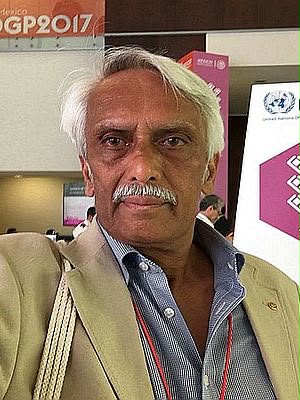
International Director & Founder, Saving Lives International CIO, UK
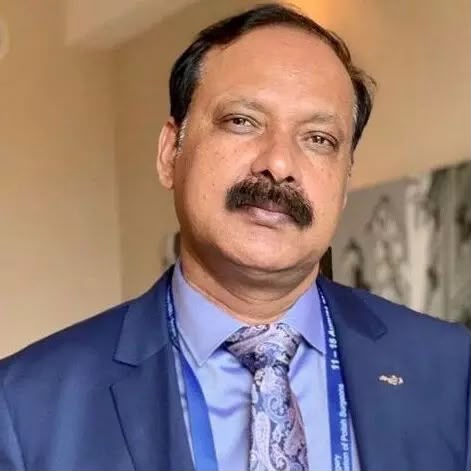
Executive Director, All India Institute of Medical Sciences – Guwahati
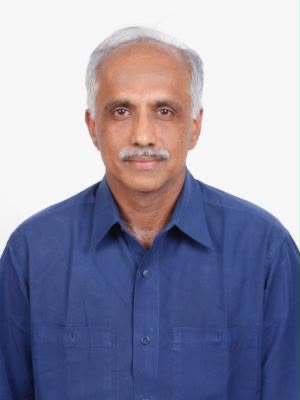
South Asia Clinical Development Director, Saving Lives International · HoD Emergency Medicine, Principal – Sri Ramachandra Faculty of Allied Health Sciences, Chennai, India
Hosted by
- ◆All India Institute of Medical Sciences – Guwahati, Assam
- ◆Sri Ramachandra Institute of Higher Education & Research, Chennai
- ◆Saving Lives International – Birmingham, UK Humanitarian Charity
With special support from
- ◆World Association of Disaster & Emergency Medicine (WADEM)
- ◆Faculty of Catastrophe & Conflict Medicine, Centre for Health Studies, Society of Apothecaries, London
- ◆Faculty of Pre-Hospital Care, Royal College of Surgeons of Edinburgh
Why attend?
- ✓Learn from internationally recognised leaders
- ✓Share best practice with colleagues from LMICs
- ✓Build international partnerships
- ✓Contribute to practical solutions for Disaster Medicine and Global Health Security
- ✓Help shape the Global Alliance for Disaster Medicine and Health Security
- ✓Network with disaster & emergency medicine specialists, universities, NGOs, humanitarian organisations, and international agencies
Registration fees
We are committed to making this international workshop accessible and affordable for healthcare professionals from low- and middle-income countries. Enquiries: info@isavinglives.org.
Includes attendance at the full workshop, workshop materials, coffee and refreshments, and lunch on all workshop days.
Available for registrations and payments completed on or before 15 September 2026.
Available for junior and intern doctors, nurses and paramedics. Supported places are limited and may be subject to confirmation of eligibility. Evidence of professional or training status may be requested.
Accommodation
The Workshop will be held at the India International Centre (IIC), New Delhi, which is conveniently located close to a wide range of accommodation options.
There are several 3-star, 4-star and 5-star hotels within easy travelling distance of the India International Centre, offering accommodation to suit a range of budgets.
Delegates are responsible for arranging and booking their own accommodation. We recommend searching online to identify a hotel that best meets your preferences and budget, and booking directly with the hotel or through a reputable travel booking website.
Affordable Uber taxi services are widely available throughout New Delhi and provide a convenient and reliable means of travelling between hotels and the India International Centre.
Refund policy
Cancellation requests must be submitted in writing by email to the Workshop Secretariat.
- ◆Cancellations received on or before 30 September 2026 will be eligible for a 50% refund of the registration fee paid.
- ◆No refunds will be made for cancellations received after 30 September 2026.
- ◆Registration fees may not be transferred to another event.
- ◆Substitutions of delegates from the same organisation may be accepted with prior written approval from the Workshop Secretariat.
- ◆Any applicable bank charges or payment processing fees incurred in issuing a refund will be deducted from the refund amount.
By submitting this registration form, participants acknowledge and accept the Workshop Refund Policy.
The Workshop is Endorsed by

The Royal College of Surgeons of Edinburgh
Faculty of Catastrophe & Conflict Medicine